This post may contain affiliate links. Please read my terms & conditions for more info.
This is a guest post written by Ethical Consumer: the alternative consumer organisation
Many of us are starting to question our choices when it comes to fashion. For too long, fast fashion has ruled our high streets, and advertisers and influencers have encouraged us to buy more to keep up with fads and trends.
Consumer clothing purchases increased 60% between 2000-2014, and this over-consumption is having long-lasting, negative effects. We know that there are huge problems in supply chains, with forced labour and unfair wages powering low prices. Many of the processes used to produce clothing are wasteful, polluting and consume large amounts of water. Added to this, the fashion industry is responsible for up to 10% of global carbon emissions, and textiles use 15% of all plastics produced.
It can be a tricky business navigating the greenwash and finding clothing brands that are truly doing good. Emma Oddie from Ethical Consumer Magazine explains why choosing sustainable and ethical fabrics is a great place to start and how a large proportion of the problems with fashion sit within the materials used to make our clothes.
The good, the not-too-bad and the ugly
Clothes are often made from a complex mix of fabrics that give certain characteristics to the item, making it warm, soft, long-lasting, anti-iron or able to absorb and maintain vibrant colours or patterns. The fabrics and their proportions must be included on the tag, and this already provides a wealth of information on how ethical and sustainable your item might be.
Some fabrics are clearly better than others, for you, for the environment, for the people who make them and for animals.
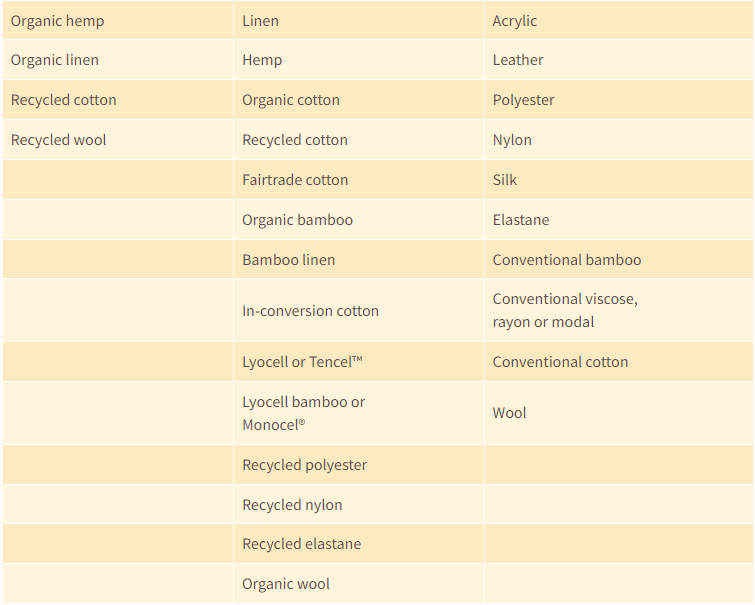
We’ve used extensive research in our recent report to group fabrics into three main groups:
- The good – actively search out items that use these materials wherever possible.
- The not-too-bad – although there are still considerable issues with these materials, they are reasonably good alternatives.
- The ugly – avoid these materials wherever possible.
Good
The not-too bad
The ugly
Unpicking the fabric of fashion
So, let’s dig a little deeper to understand the issues behind different fabrics and explore the more ethical and sustainable options available.
Cotton
Cotton probably already forms a large proportion of the clothing in your wardrobe. In fact, cotton makes up a quarter of all textiles. Smallholders grow nearly all of the cotton used in our clothes but the seed supply for this industry is big business. In the quest to increase yields, three-quarters of crops are grown from genetically modified (GM) seeds. GM cotton is linked to reduced biodiversity, in some instances has led to the increased use of insecticides, and has forced many farmers to buy more seeds each year from large, controlling companies.
By choosing organic cotton, you can be sure that your clothes are GM and synthetic-pesticide-free. Look for the Soil Association symbol (which guarantees 95% certified organic fibres) or ‘made with organic’ (which guarantees 70%).
Another label that is becoming more popular is the Better Cotton Initiative (BCI). Although it’s better than nothing and it is good to see initiatives starting to address issues in the industry, it has notoriously low standards. One such issue is the human rights issues linked to cotton farming. Membership of the BCI means that affiliated brands refuse cotton from Uzbekistan and Turkmenistan; the governments of both countries have forcibly mobilised citizens to grow and harvest cotton. However, the initiative still allows cotton from the Xinjiang Uyghur Autonomous Region of China where an estimated 500,000 Uyghur workers are forced to work as cotton pickers after release from ‘re-education camps’ used to ‘cleanse’ ethnic minorities of their ‘extremist thoughts’.
The BCI also still condones the use of GM crops and pesticides.
So, in summary, if you buy cotton, look for recycled fibres. Although recycled cotton is often combined with virgin cotton or other recycled material to increase the strength of the fibres, there is an increasing number of options out there. If you can’t buy recycled, buy organic.
Also, look for Fair Trade labels that ensure full traceability in the supply chain, guarantee a fair wage for workers and contain no GM crops. Fairtrade works with smallholder cotton farmers in Asia and Africa to help form organisations and combine their efforts to have a stronger voice in the supply chain. As a result, farmers receive a fairer price for their cotton and can make their processes more productive. The organisation is also having an impact on gender equity, ensuring female workers receive their wages directly, rather than having them paid to a male family member.
Synthetics
Synthetics cover a range of fabrics all made from plastics – including acrylic, polyester and nylon. Polyester is a cheap mainstay in the fast fashion industry and it’s found in 50% of all textiles produced. Many items may quote recycled polyester on the label, although the levels of recycled content are often very low and the rest is made up from virgin plastic.
Although 100% recycled synthetics are a better choice, this doesn’t remove the microfibre problem. Plastic-based materials will shed microplastics as they are worn, laundered and disposed of and this plastic can make its way to oceans. The true scale of the microplastic problem is still up for debate but initial indications don’t look good. If you already have synthetic clothes in your wardrobe, use a guppy bag to stop microfibres disappearing down the drain during washing.
Viscose, rayon or modal
These natural fabrics are often used as an alternative to cotton but, although they are natural, they are often extracted using toxic chemicals which is bad news for the environment, workers and local communities. Fabrics named as Lyocell, Tencel™ or Monocel® use closed-loop manufacturing, meaning that the chemicals are recycled within the system rather than released into the environment, making them a much better alternative. Bamboo linen can also be another more environmentally-friendly option, where fibres are extracted by mechanical means.
Since viscose, rayon and modal are often made from wood pulp, opt for brands that promise sustainable forestry and aren’t linked to deforestation.
Silk, leather and wool
These fabrics are often linked to big animal rights issues. Even wool production, where the animals are not directly killed to produce the fabric, is littered with problems.
Mulesing, (where a section of the sheep’s rump is removed without anaesthetic to control parasites) is still used routinely in Australia, the largest producer of merino wool. Tail docking, castration and ear clipping without anaesthesia are still common throughout the world, and once the sheep have come to the end of their productive time (around five years) they are often live transported for the food industry.
Recycled wool is an ethical and sustainable alternative since it doesn’t profit the wool industry, and organic wool is the next best thing since animal rights standards are much higher.
The choice really is yours
There are so many smaller ethical and sustainable brands out there creating slow fashion with love and respect for the environment and every person in the supply chain. Of course, it is always right to reuse what you have, reduce your consumption and buy second-hand wherever possible, but if you are looking for some new items, check out our guide to ethical fashion brands and our recommended Best Buys.
For more information on ethical consumption and to see our detailed guides on everything from fashion and beauty to banks and washing machines, visit the Ethical Consumer website.
Header image by Cristofer Maximilian on Unsplash
About Gina Caro
Gina is a content creator and award-winning blogger. Her aim is to help you live a more sustainable & simple life. Her blog covers zero waste, minimalism, wellbeing & thrift. She currently lives in Cornwall with her partner, two kids and Charles the dog.

Guest Post
This is a guest post written by Ethical Consumer.
As always, I only ever recommend products or services that I either use myself or I feel will help you to live a more sustainable lifestyle.
For more info visit my terms & conditions page.